
Kenya is one of the most exciting places on the African continent to build a career or a business right now. Nairobi is a regional headquarters city for multinational companies, a technology and financial hub, and increasingly the destination of choice for professionals, investors, and entrepreneurs from across the world. If you are a foreign national who wants to be part of what is happening here, the opportunity is real.
But there is a door you have to walk through first — and that door is called a work permit.
The permit process in Kenya is not casual, and it is not forgiving of shortcuts. It is procedural, it is document-intensive, and it moves on its own timeline. The foreign nationals who navigate it well are the ones who go in prepared, choose the right permit class from the beginning, and work with people who know the system from the inside.
That is exactly what Spondoo Kenya is here to help you do.
A work permit is an authorisation issued by Kenya's Directorate of Immigration Services under Section 40 of the Kenya Citizenship and Immigration Act of 2011. It is the legal instrument that gives a foreign national the right to work, run a business, practise a profession, or engage in specific commercial activity in Kenya.
It is not the same as a visa. Kenya's Electronic Travel Authorisation — the eTA that replaced the traditional visa system in 2023 — allows entry and a stay of up to 90 days for visitor purposes. It does not authorise work. It does not authorise managing a business operationally. It does not authorise conducting commercial transactions on behalf of a Kenyan entity.
Working in Kenya without a valid permit is a violation of the Kenya Citizenship and Immigration Act. The consequences include fines, deportation, and restrictions on future entry. For employers who allow foreign nationals to work without permits, the consequences are equally serious. This is not an area where it pays to guess, wait, or proceed informally.
All permit applications in Kenya are now submitted through the government's eFNS portal — the Electronic Foreign Nationals Services system. The process is online, trackable, and auditable. Once submitted, applications are reviewed by the Permit Determination Committee, an inter-ministerial body appointed under the Kenya Citizenship and Immigration Act.
Kenya issues work permits across multiple classes, each designed for a specific type of economic activity. Submitting an application under the wrong class is not a minor administrative error — it will result in rejection or deferral, and starting again costs time, money, and momentum.
Here is what the most relevant classes cover.
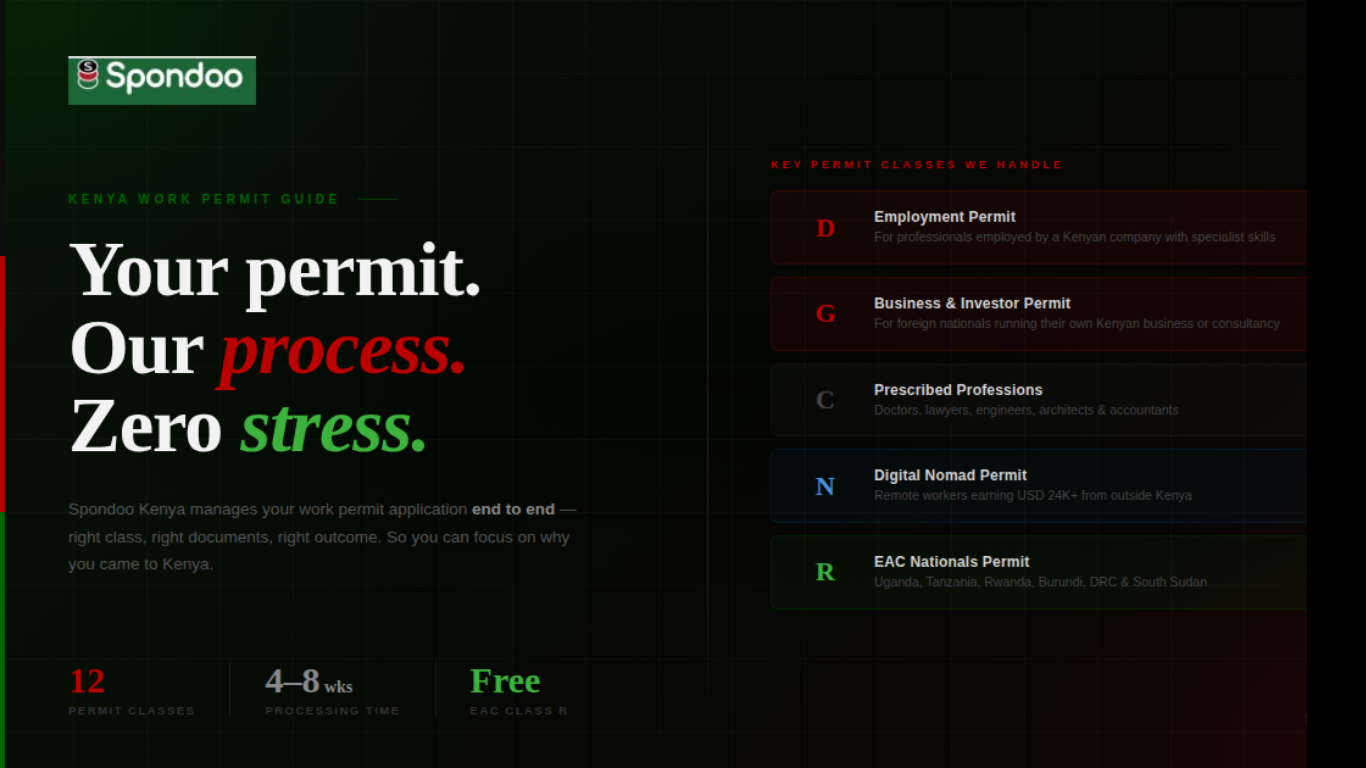
Class D is the most common permit for foreign nationals coming to work for a Kenyan employer. It covers specific employment with a named employer in a defined role. The employer makes the application, must demonstrate that the role requires skills not available locally, and must nominate a Kenyan understudy who will be trained to eventually take over.
Class G covers independent commercial activity — running a business, trade, or consultancy through a Kenyan-registered entity. It is for foreign nationals who are operating their own business rather than working for someone else's. A minimum investment of USD 100,000 is the standard threshold.
Class C is for members of formally regulated professions — doctors, lawyers, engineers, architects, and accountants among them — who intend to practise their profession in Kenya. This permit operates alongside, and does not replace, registration with the relevant Kenyan professional body.
Class N, introduced in October 2024, is the Digital Nomad Permit — for foreign nationals employed by companies based outside Kenya or working as freelancers for foreign clients, who wish to live in Kenya while working remotely. Applicants must demonstrate a guaranteed annual income of at least USD 24,000 from non-Kenyan sources.
Class R, also introduced in 2024, is for citizens of EAC member states — Burundi, DRC, Rwanda, South Sudan, Tanzania, and Uganda. It covers employment, business, trade, and professional activities under a single permit, and is entirely free of charge.
Class A, B, and F cover mining and prospecting, agriculture and animal husbandry, and manufacturing respectively — for those entering Kenya's industrial and primary sectors.
Class I — following the 2024 reforms — now applies exclusively to those directly engaged in religious ministry and preaching. Professionals working within faith-based organisations in non-religious roles now apply under the newly introduced Class Q.
Class P was introduced to allow UN, diplomatic mission, and inter-governmental organisation staff posted to neighbouring hardship countries — such as South Sudan or Somalia — to reside in Nairobi legally with their families.
The documentation behind a work permit application is substantial — and it is our job, not yours, to know exactly what is required, how it must be presented, and in what order it must be submitted. What we do need from you is straightforward: your passport, your professional qualifications and credentials, a police clearance certificate from your home country, and an honest account of your situation — what you plan to do in Kenya, who you will be working with or for, and what your timeline looks like.
Everything else — the forms, the cover letters, the justification arguments, the employer documentation, the KRA compliance checks, the portal submissions — we handle. We will tell you precisely what we need from you, when we need it, and in what format. You will not be left guessing, chasing paperwork blindly, or submitting documents that turn out to be missing a certification.
The one thing that is genuinely in your hands is your police clearance certificate. This must be issued from your country of habitual residence, must be no more than six months old at the time of submission, and in some countries takes several weeks to obtain. If you are planning a move to Kenya, starting this process early is the single most practical thing you can do before we begin.
From the moment you engage us, the process is ours to manage. We begin by assessing your specific situation — your role, your employer, your intended activity, your nationality — and identifying the exact permit class that applies. This is not a guess. It is a considered professional assessment, and getting it right at this stage is what prevents rejections, deferrals, and the cost of starting over.
We then build your complete application file. For Class D and Class G applications — the two most common classes for employed professionals and business owners — this includes drafting the justification letter, a critical document addressed to the Director General of Immigration Services that must convincingly demonstrate that the foreign national's skills or business purpose cannot be sourced locally, and that the engagement genuinely benefits Kenya. This letter carries more weight in the determination process than most applicants realise, and it is the single most common reason applications are deferred when it is vague, generic, or unconvincing. For other permit classes, the equivalent narrative elements of the application are handled with the same rigour. Every document is properly certified, translated where required, and structured to present your application in its strongest possible form before it reaches the Permit Determination Committee.
We submit through the eFNS portal, manage all payment stages, monitor the application actively, and respond to any queries raised by the Directorate of Immigration Services quickly and accurately. Slow responses to immigration queries are one of the most common causes of avoidable delays — we make sure that does not happen on your application.
Once your permit is approved and endorsed, we also handle the steps that most people do not think about until they need them: your Foreign National Certificate registration, your KRA tax registration if required, and any company compliance obligations that connect to your immigration status. A work permit is the beginning of your Kenyan compliance structure, not the end of it. We make sure the whole structure is properly built.
Realistic timelines matter. Many foreign nationals and the companies employing them underestimate the time the process requires and create problems for themselves as a result.
For a complete, well-prepared application, the processing window at the Directorate of Immigration Services is typically four to eight weeks from submission. However, the full timeline — from beginning document preparation to receiving an endorsed permit — realistically runs between three and five months. This accounts for the time needed to gather and certify documents, the initial review period, any queries raised by immigration, the issuance payment stage, and the physical endorsement process.
Permit renewals should be initiated at least three months before the existing permit expires. If you apply for renewal before expiry, you are generally permitted to continue working while the renewal is processed, provided you retain proof of the application submission.
If your situation requires you to begin work before the full permit is in place, a Special Pass can be applied for — but only where a substantive permit application has already been submitted. The Special Pass covers a defined period, typically three months, and is a bridge rather than a standalone solution.
At Spondoo Kenya, we are not a generic immigration service. We are Chartered Accountants and business compliance specialists who understand that a work permit is not a standalone document — it is the first layer of a compliance structure that also includes KRA tax registration, company registration, PAYE obligations, and financial reporting requirements.
When we support a work permit application, we bring that full picture to the process. We assess which permit class applies to your specific situation. We review and advise on the documentation before anything is submitted. We help draft or review the justification letter — the element that most often determines whether an application succeeds or stalls. We manage the eFNS submission process and monitor the application through to approval. And where your permit connects to broader compliance requirements — tax registration, company setup, reporting obligations — we handle those too.
The result is not just a permit. It is a properly structured entry into the Kenyan compliance environment, built on a foundation that holds up when it matters.
We have seen what happens when the process is handled without the right guidance. Applications rejected because of a poorly written letter. Executives working illegally because the permit was assumed to be in progress when it had not yet been submitted. Companies exposed to compliance risk because nobody connected the immigration layer to the tax layer.
We exist to make sure that does not happen to you.
Whether you are an individual professional planning a move to Kenya, a company onboarding international talent, an investor establishing a business, or a digital professional drawn by Kenya's growing reputation as a remote work destination, we can help you identify the right permit, prepare a strong application, and move through the process with confidence.
The consultation is top-notch. The guidance is practical. And the outcome — a correctly issued, properly documented work permit — is the foundation on which everything else you want to build in Kenya rests.
Book your consultation with Spondoo Kenya today.
[Get in touch → spondoo.ke]