

As Kenya enters the 2026 tax year, many businesses—small, medium, and large—are searching for reliable guidance on Corporate Tax Instalments in Kenya. Instalment tax remains one of the most common areas where companies face penalties from KRA, simply because many business owners do not fully understand how the system works, when payments are due, or how to calculate their instalments correctly.
This article breaks everything down in simple, clear language so Kenyan companies can confidently stay compliant, avoid unnecessary penalties, and plan their taxes smoothly throughout 2026.
Corporate tax instalments are advance tax payments made to the Kenya Revenue Authority (KRA) during the year. Instead of waiting until year-end to pay the full corporate tax amount, companies pay four instalments spread throughout the financial year.
Instalment tax is calculated based on either:
Last year’s corporate tax payable (the prior-year basis), or
Projected profits for the current year (the current-year estimate method).
This system ensures:
Businesses avoid one large lump-sum payment at year-end
KRA receives revenue consistently throughout the year
Companies improve cash flow planning and financial predictability
The 2026 tax year is expected to bring stricter compliance due to:
Enhanced KRA monitoring systems
Automated detection of late or incorrect instalments in iTax
Increased underpayment penalties
Higher risks for SMEs that fail to forecast correctly
A simple miscalculation, missed deadline, or underestimated profit projection can trigger automatic penalties and accumulating interest.
There are two official methods approved by KRA. Below is the simplest guide to each method.
This method is best when your business expects similar profits to the previous year.
Formula:
Instalment Amount = Previous Year’s Corporate Tax ÷ 4
If your business paid KES 1,200,000 in tax last year:
KES 1,200,000 ÷ 4 = KES 300,000 per instalment
This method is simple, safe, and preferred by most businesses to avoid miscalculations and penalties.
Use this method when you expect major changes in profits.
Estimate your taxable profit for 2026
Apply the corporate tax rate (usually 30%)
Divide the tax into four equal instalments
If your projected profit for 2026 is KES 6,000,000:
Corporate tax = 30% × 6,000,000
Tax payable = KES 1,800,000
Instalment = KES 450,000 each
If your estimate turns out too low, KRA will apply:
20% underpayment penalty, plus
1% monthly interest on the unpaid balance
Because of this, most Kenyan companies prefer the prior-year method unless professionally assisted by tax experts.
Kenyan companies must pay instalment tax four times a year. For calendar year taxpayers, deadlines are:
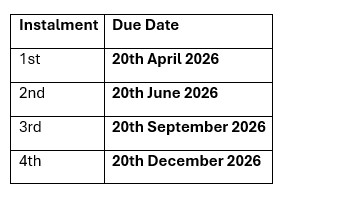
Companies using a non-calendar financial year follow instalment deadlines based on:
End of 4th month
End of 6th month
End of 9th month
End of 12th month
Missing any of these deadlines leads to automatic penalties.
The biggest challenge for businesses is accurately forecasting income. The following techniques help ensure you stay compliant and avoid penalties.
Review:
Profit trends for the last 3 years
Seasonal income fluctuations
Long-term contracts
Revenue growth or decline patterns
This reduces errors in estimating taxable profit.
Good cash flow planning ensures instalments are paid on time without straining the business.
Top strategies include:
Setting aside a monthly tax reserve
Using invoicing software to track receivables
Monitoring expenses closely
Predict upcoming cash shortages early
Tools used by professional accountants in Kenya include:
Cloud accounting platforms
Automated tax calculators
Financial dashboards
Profit forecasting software
KRA applies penalties automatically through iTax. Here is the complete breakdown:
If a corporation tax instalment is paid after the due date, the following charges apply:
A flat 5% of the unpaid tax is charged immediately.
KRA additionally charges:
1% interest per month,
Compounded on the outstanding amount,
And continues accruing until full payment is made.
This continues even if the delay is accidental.
If instalments are too low throughout the year, resulting in a big balance due during annual filing, KRA charges:
Applied on the difference between:
Actual corporate tax liability – Total instalments paid
This penalty applies even if instalments were paid on time — as long as they were under-calculated.
Failing to comply with instalment requirements may trigger:
The system automatically posts penalties without human review.
KRA may:
Freeze your bank accounts via Agency Notices
Recover unpaid taxes from clients or suppliers
Start legal enforcement
Impose restrictions on tax compliance certificates
These are separate from instalment penalties.
If your business anticipates difficulty:
You may request:
Extended payment arrangements
Time-based instalment plans
Waivers on penalties or interest (not guaranteed)
However:
The principal tax must still be paid in full.
Early communication reduces risk and shows good compliance behaviour.
All instalment tax obligations must be managed through:
KRA iTax Portal (official payment & filing platform)
KRA Contact Centre (for account issues or reconciliations)
Take the guesswork out of instalment tax. With Spondoo Kenya, you get accurate tax calculations, proactive forecasting, and full KRA compliance support—ensuring your business stays penalty-free and financially confident throughout 2026. Get expert help today and let us handle your corporate tax while you focus on growth.