
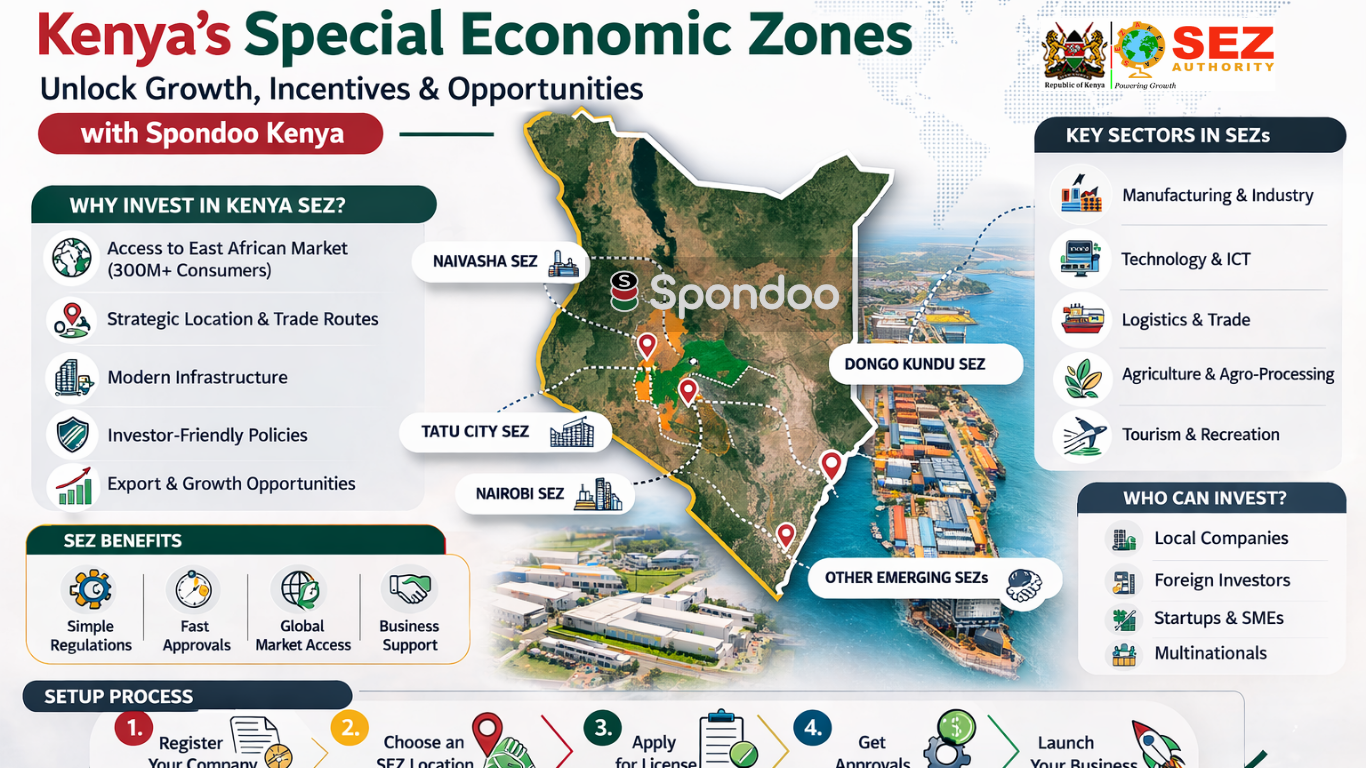
Kenya has emerged as one of Africa’s fastest-growing investment destinations. With its strategic location, modern infrastructure, and business-friendly policies, the country continues to attract global investors looking to expand into the East African market.
One of the most attractive opportunities for investors today is establishing a business in Kenya’s Special Economic Zones (SEZs). These zones provide unique incentives such as tax benefits, simplified regulations, and world-class infrastructure designed to support international businesses.
However, navigating the legal and regulatory process can be complex, particularly for foreign investors unfamiliar with Kenya’s business environment. That’s where Spondoo Kenya comes in. As a professional business consultancy, Spondoo Kenya assists investors with company registration, SEZ licensing, and regulatory compliance, ensuring a smooth and efficient setup process.
If you are considering investing in Kenya, setting up your business in an SEZ with the support of Spondoo Kenya could be your smartest move.
Special Economic Zones are designated areas where businesses operate under unique economic regulations that differ from the rest of the country.
These zones are designed to:
Attract both domestic and foreign direct investment
Promote industrial development
Increase exports
Create employment opportunities
Strengthen Kenya’s economic competitiveness
The Special Economic Zones Authority (SEZA) is the institution responsible for promoting and regulating these zones. SEZA works to attract, facilitate, and retain investment in SEZs while ensuring investors benefit from the incentives and infrastructure available within the zones.
SEZA also regulates both public and private SEZ developments across the country. By creating integrated infrastructure and offering investor-friendly incentives, the authority aims to remove barriers to doing business and strengthen Kenya’s position as Eastern Africa’s most vibrant economic hub.
Through this initiative, the government is promoting industrial development, job creation, export growth, and technology innovation.
Kenya’s SEZ framework supports a wide range of industries, allowing investors to choose the sector that best aligns with their business objectives.
Industrial parks within SEZs provide integrated infrastructure that supports manufacturing and processing industries.
These zones are particularly attractive for export-oriented production and industrial growth.
Examples include:
Automotive assembly
Textile and apparel production
Electronics manufacturing
Food processing
Kenya is widely known as the “Silicon Savannah” due to its fast-growing technology sector. These parks are designed to promote technology innovation and digital services.
ICT parks in SEZs support:
Software development
Technology startups
Research and innovation
Digital service companies
These zones help technology companies scale their operations while benefiting from supportive infrastructure.
Business service parks provide plug-and-play infrastructure for multinational companies establishing regional offices in Kenya. They support corporate services such as finance, consulting, and administration.
Free trade zones are designed for logistics companies and trading businesses involved in regional distribution.
Activities include:
Offloading, storage and warehousing
Packaging and repackaging
Goods distribution
These zones simplify international trade and reduce operational barriers.
Free port zones allow goods to be treated as though they are outside the national customs territory. This simplifies international trade operations and allows businesses to import, process, and export goods efficiently.
Kenya’s agricultural sector is one of the largest contributors to the country’s economy. These zones focus on strengthening agricultural value chains and improving productivity in livestock and agribusiness industries.
Specialized agricultural SEZs support:
Agro-processing
Livestock value chains
Agricultural exports
These zones enhance productivity and create opportunities for agribusiness investors.
Science and technology parks are designed to promote innovation and advanced research, particularly in the ICT and technology sectors.
Tourism is another key industry in Kenya. Special zones support investments in:
Hotels and resorts
Recreational and leisure facilities
Tourism services
These zones help expand Kenya’s tourism infrastructure.
Businesses operating within Kenya’s SEZ framework must obtain the appropriate license from the Special Economic Zones Authority.
A developer license is issued to corporate entities responsible for developing infrastructure within a gazetted SEZ. These developers build industrial parks, business facilities, and integrated infrastructure that support businesses operating within the zone.
An operator license is issued to companies responsible for managing SEZ facilities and services. Operators oversee daily activities within the zone and ensure efficient operations.
Most investors looking to establish businesses in Kenya’s SEZ will apply for an Enterprise License.
It is issued to companies that want to operate businesses within the SEZ. This license allows businesses to conduct activities such as manufacturing, logistics, technology services, and export trading within the zone.
Kenya has established several Special Economic Zones to support industrial growth and international investment.
The Naivasha SEZ is one of Kenya’s largest industrial investment hubs.
It focuses on:
Industrial manufacturing
Energy-intensive industries
Export-oriented production
The zone benefits from proximity to geothermal power sources, providing reliable and affordable energy for manufacturing companies.
The Dongo Kundu SEZ is located near the Port of Mombasa and is designed to support international trade.
Key sectors include:
Port logistics
Maritime trade
Export manufacturing
Its strategic location makes it ideal for businesses involved in global supply chains and regional distribution.
Located in Mombasa, the Dongo Kundu SEZ supports maritime trade, logistics services, and manufacturing activities linked to Kenya’s port infrastructure.
Several SEZ projects near Nairobi focus on technology, business services, and innovation-driven industries.
The Athi River SEZ is a major industrial area located near Nairobi.
It supports:
Industrial production
Manufacturing industries
Export processing activities
The location benefits from strong transport connectivity and proximity to Nairobi’s business ecosystem.
Tatu City SEZ is one of the most advanced mixed-use developments in East Africa.
It focuses on:
Technology and innovation
Business services
Regional headquarters for multinational companies
The zone provides modern infrastructure designed to support technology firms and corporate service providers.
Several factors make Kenya a preferred destination for investors looking to establish businesses in Special Economic Zones.
SEZ companies benefit from various incentives designed to reduce operational costs and encourage export-oriented industries. These incentives reduce operational costs and support export-oriented industries.
Kenya provides access to the East African Community (EAC) market, which includes more than 300 million consumers.
This allows businesses operating in Kenya to easily expand into neighboring countries.
SEZ developments provide modern industrial infrastructure, reliable energy supply, transport and logistics networks and digital communication systems.
The Kenyan government actively promotes investment through policies that encourage private sector development and foreign direct investment.
While Kenya offers significant investment opportunities, the process of establishing a business in an SEZ can involve multiple regulatory steps.
Spondoo Kenya provides professional assistance to investors throughout the entire company setup process.
Spondoo Kenya helps investors register companies in Kenya, ensuring compliance with local corporate regulations.
We assist clients in preparing and submitting SEZ license applications to the Special Economic Zones Authority.
SpondooKE ensures that businesses meet all regulatory requirements, including documentation, licensing, tax registration, and government approvals.
In addition to setup services, Spondoo provides strategic guidance to help investors select the most suitable SEZ location and business structure.
With expert support, investors can avoid delays and ensure their business setup process is completed efficiently.
Starting a company in a Special Economic Zone typically involves the following steps:
Register a company in Kenya
Identify a suitable Special Economic Zone location
Prepare investment plans and documentation
Apply for the SEZ Enterprise License
Obtain approvals and begin operations
Working with experienced consultants like Spondoo Kenya can significantly simplify this process and help investors launch their businesses faster.
A Special Economic Zone is a designated investment area where businesses benefit from special regulations and incentives designed to attract investment.
Yes. Kenya actively encourages foreign direct investment and allows foreign investors to establish companies within Special Economic Zones.
Most investors require an Enterprise License, which allows them to operate businesses within the SEZ.
The timeline depends on the completeness of documentation and regulatory approvals.
Working with professional consultants can help speed up the process.
Spondoo Kenya helps investors navigate the regulatory process, prepare documentation, and ensure a smooth company setup process.
Kenya offers one of the most attractive investment environments in Africa, and Special Economic Zones provide the ideal platform for global companies to grow.
With Spondoo Kenya, you get expert support for company registration, SEZ licensing, and regulatory compliance.
Ready to start your SEZ investment in Kenya?
Contact Spondoo Kenya today and let our experts help you register your company, obtain SEZ licenses, and launch your business successfully. 🚀