
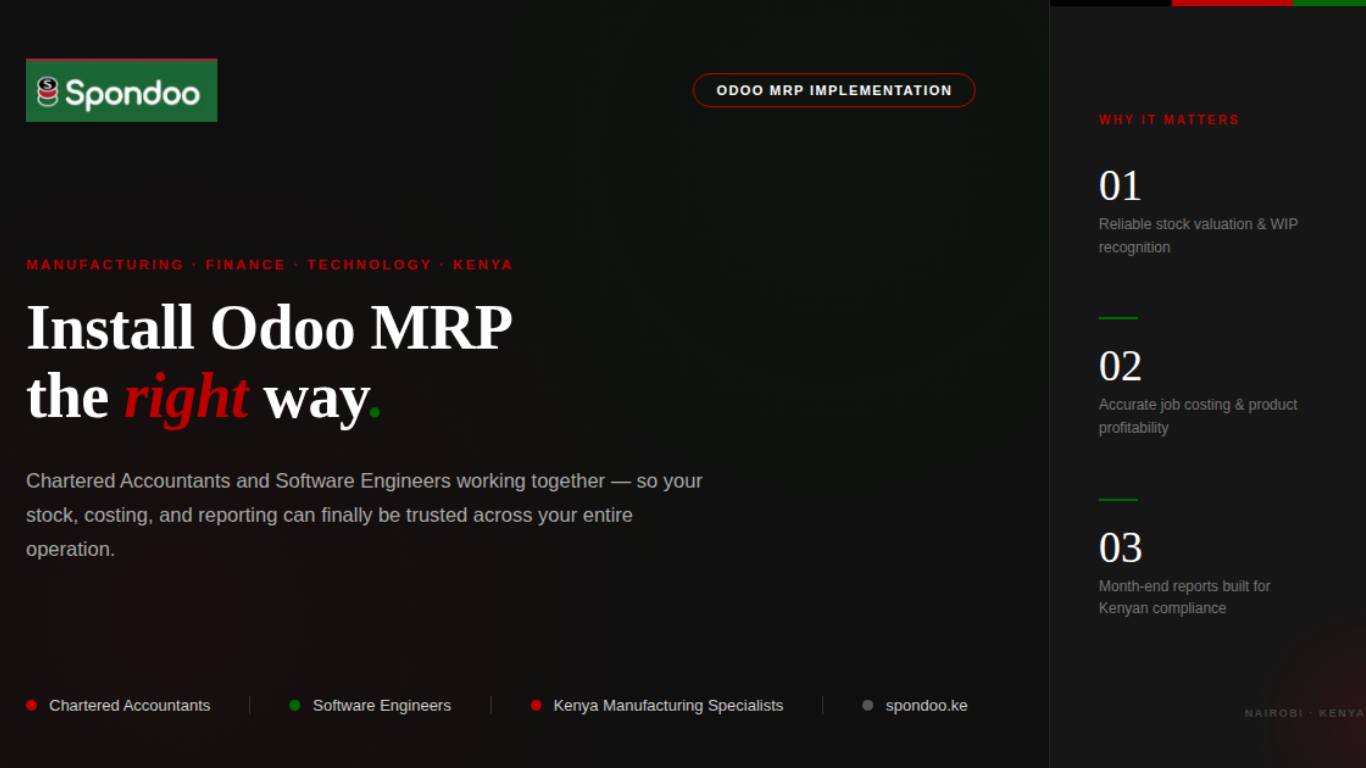
For manufacturing and production businesses in Kenya, growth brings complexity very quickly. More products, more suppliers, more stock locations, more staff, and more reporting demands can turn a simple operation into a difficult one to control. Many businesses reach a point where spreadsheets, basic inventory tools, and disconnected accounting records are no longer enough.
That is where Odoo MRP can become a powerful solution. But only if it is installed properly.
At Spondoo Kenya, we believe Odoo MRP should be implemented by proper Chartered Accountants and Software Engineers — not by technical teams alone. A manufacturing system affects production, stock, purchasing, costing, finance, and management decisions. It needs to be built with both system logic and accounting accuracy in mind.
A proper Odoo MRP installation needs to answer important financial questions from day one. How is stock valued? How is work in progress treated? How are production costs captured? How are wastage and scrap handled? Can product margins be trusted? Does the system support clean monthly reporting? Are the accounting entries aligned with the real business process?
This is where Chartered Accountants add real value. They help ensure the system does not just process transactions, but produces numbers that management can actually rely on.
Without this level of thinking built in from the start, businesses face the same problems again and again. Stock figures that do not tie up. Inconsistent product costing. Incorrect gross profit reporting. Weak control over purchase and production leakage. Difficult year-end accounting. Management accounts that cannot be trusted. These are not software problems — they are implementation problems. And they are entirely avoidable when the right financial expertise is in the room from the beginning.
At the same time, even the best financial design will fail if the software is poorly built.
Experienced Software Engineers are needed to configure Odoo correctly, customise workflows where necessary, handle integrations cleanly, structure user roles and approvals, support warehouse and production logic, automate repetitive tasks safely, migrate data accurately, and ensure long-term stability of the platform.
A rushed technical build often creates future problems that are difficult to trace. A process may work for one department while causing issues elsewhere. Production completion might look correct operationally, but the cost movements, stock postings, or reporting output may be entirely wrong. These hidden failures do not announce themselves — they quietly undermine the numbers until someone notices the discrepancy, by which point the damage is already done.
A strong engineering team prevents that from happening.
A good Odoo MRP project should be built around the realities of the business — not around a standard template or a generic demo configuration.
That means reviewing product lines and manufacturing methods, bills of materials and component structures, warehouse flows and stock locations, procurement and supplier processes, batch tracking and traceability, work centres and routing, labour and overhead treatment, approval controls, management reporting requirements, and finance integration with the correct tax implications for Kenya.
The goal is not just to install software. The goal is to create a working system that improves control and visibility across the entire business — one that the production floor, the stores function, the finance team, and the management team can all use with confidence.
A properly installed Odoo MRP system can help Kenyan businesses reduce stock losses and shortages, improve production planning, manage procurement more effectively, understand product profitability, strengthen internal controls, support management decisions with better data, reduce manual reporting effort, and create a stronger operational foundation for growth.
For owner-managed businesses, this is particularly valuable. Decision-makers need clear numbers, not guesswork. They need to know which products make money, where inefficiencies sit, and what the business needs next. A well-implemented system gives them that visibility without requiring three days of manual reconciliation before every board meeting.
The Kenyan manufacturing environment demands practical systems. Businesses here operate with real supply chain pressure, currency considerations, multi-location complexity, and growing regulatory expectations around tax reporting and compliance. An Odoo MRP system implemented with those realities in mind is a fundamentally different thing from one that is simply configured and handed over.
If you are investing in Odoo MRP, the right implementation partner matters just as much as the software itself.
You need a team that understands production processes, financial reporting, internal controls, and system engineering. You need more than coders. You need more than accountants working in isolation. You need both — working together, from the very beginning, with a clear understanding of what the business actually needs to produce.
That is how you turn software into a real business asset.
That is what Spondoo Kenya is built to do.
Ready to implement Odoo MRP the right way in Kenya? We will tell you honestly what your business needs, what a proper implementation looks like, and how to get from where you are now to a system you can trust.
Book a free discovery call with Spondoo Kenya →